Professional Hair Color at Home: The Complete 2026 KEUNE Guide
-
 Laura Mohiuddin
- Posted on
- 0 comments
Box dye instructions leave no room for your hair type, porosity or grey percentage — that's usually why the result looks nothing like the packaging. Professional hair color at home means using a real formula and a colorist's technique, not just following the box. Here's how, with KEUNE Tinta Color.
You followed the box instructions exactly, waited the full processing time, rinsed, and dried your hair — only to find the color looked nothing like the shade on the packaging. Too dark, too brassy, or patchy in a way you can't quite explain. The problem usually isn't your technique; it's that most consumer box dyes are built for simplicity, not precision, and simplicity leaves no room for your specific hair type, porosity, or grey percentage.
Professional hair color at home comes down to three things: the formula you choose, how you apply it, and what you do afterward. This guide covers all three, using KEUNE Tinta Color, a salon-grade oxidative color system available through Timeless BD.
Choosing the Right Formula and Shade Before You Start
The biggest reason at-home color goes wrong happens before the product touches a single strand. A mismatched formula or shade level creates problems no technique can fix — getting professional hair color at home right starts with this decision, not the application itself.
Permanent vs. demi-permanent vs. ammonia-free
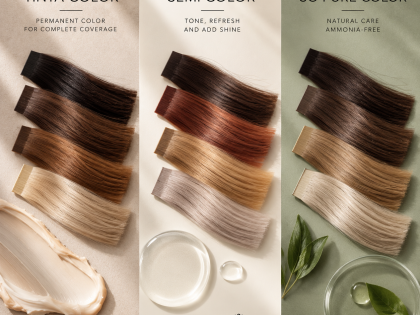
Permanent color is designed for long-lasting color and can provide full grey coverage when the appropriate shade and formula are used. Demi-permanent color deposits tone with less lift and fades gradually over roughly 24 shampoos, making it better suited to tonal refreshes or blending early grey. Ammonia-free is a separate characteristic, not a separate category — an ammonia-free formula can still be fully permanent, so it doesn't automatically mean a weaker result. Choose based on your goal first, then the formula type.
Reading the shade-level number and picking your shade
Professional hair color runs on a numbering scale from 1 (black) to 10 (lightest blonde), with each level representing a different depth of color. Compare your hair to a shade chart in natural light, then consider how much grey you need to cover and the result you want. For substantial grey coverage, Tinta Color's Ultimate Cover (UC) range is specifically designed for grey coverage and is the more appropriate choice than simply selecting a fashion or tonal shade.
Not sure where to start? These are the four Tinta Color shades Timeless BD customers actually reorder most for professional hair color at home:


A strand test is not optional. Cut a small section from behind the ear or at the nape, mix Tinta Color with developer at a 1:1 ratio, saturate the strand, and process for the standard time. Rinse, dry, and check the result before committing to the full application — it's 30 minutes that can save a full head of hair.
What to Set Up Before You Open the Box
Prep is what actually separates professional hair color at home from a rushed box-dye session. Gather gloves, an applicator brush, a mixing bowl, sectioning clips, a timer and a fine-tooth comb before you mix anything. Apply petroleum jelly or a thick conditioner along your hairline, ears and the back of your neck to prevent staining — it takes ten seconds. Working without these ready means stopping mid-application to go find something, and interruptions create uneven processing time across sections.
Step-by-Step: Professional Hair Color at Home
This is where most at-home color sessions fall apart. Skipping structure leads to missed sections and uneven saturation. Here's the order a colorist would actually work in.
Divide into four sections first
Part your hair straight down the center from forehead to nape, then horizontally from ear to ear across the top. Clip all four sections out of the way. This gives you a map of exactly where you've applied color and where you haven't — most uneven results trace back to skipping this step.
Start at the back, finish at the hairline
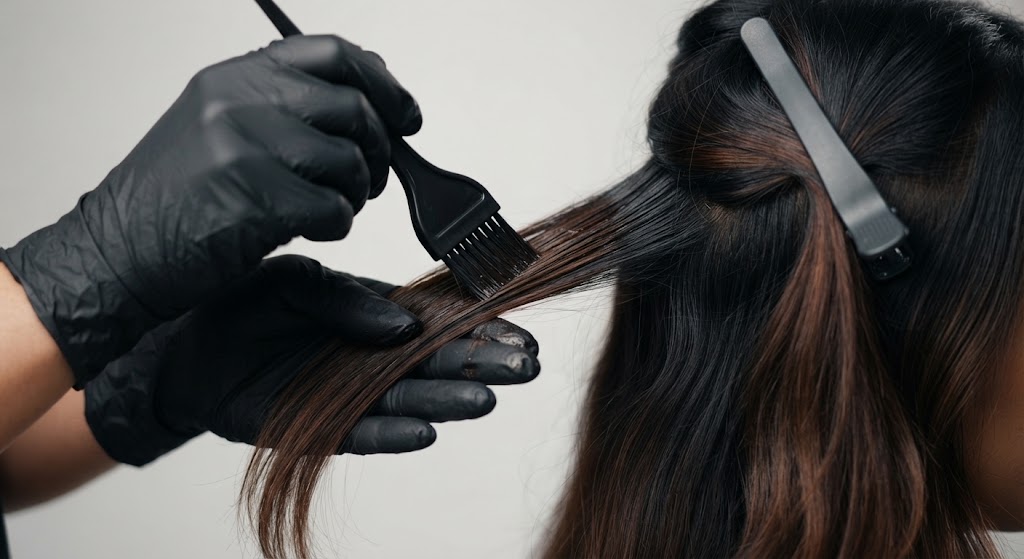
Release one back section first, since it's the hardest to see and easiest to rush. Work in partings about half an inch wide, pressing color in with the applicator brush rather than painting loosely over the surface. Fully saturate each parting before moving to the next. Work both back sections, then the two front sections, finishing at the hairline last — it's the most visible area and should get fresh product toward the end.
The root-vs-length timing colorists use
Scalp heat can make roots process differently from lengths, but the correct application order depends on whether you're coloring virgin hair, touching up regrowth, covering grey, or refreshing previously colored lengths. For a full-head application, follow the recommended application sequence for your Tinta Color formula and use your strand test to confirm the result. For a root touch-up only, apply directly to new growth and avoid unnecessary overlap onto previously colored lengths.
Processing Time and Developer Volume
The timer isn't a suggestion. Under-processing can leave uneven, muddy color, while over-processing can affect the hair and the final shade. For grey coverage at home, a 20-volume (6%) developer is commonly used with Tinta Color, but the appropriate developer depends on the shade and desired result. Mix Tinta Color with developer at the ratio specified for your formula — for the standard Tinta Color application described here, that ratio is 1:1 — and stir until fully smooth before applying anything.
| What you'll need | Size | Price |
|---|---|---|
| Tinta Color, Natural/UC shade (e.g. Dark Brown 3.00) | 60ml | ৳920 |
| 6% Developer, 20 Volume | 60ml | ৳470 |
| Care Tinta Color Shampoo (aftercare) | 300ml | ৳1,900 |
| Care Tinta Color Conditioner (aftercare) | 250ml | ৳1,950 |
Prices current as of 2026. For the full shade range and every Tinta Color price point, see our hair color price in Bangladesh guide.

6% Developer, 20 Volume
A 20-volume developer used for Tinta Color applications where that strength is appropriate for the chosen shade and desired result.
Shop Developer →
Care Tinta Color Shampoo
Sulphate-free, formulated for color-treated hair with UV protection and color-sealing agents a regular shampoo doesn't carry.
Shop Shampoo →At the midpoint of processing, wipe a small area clean with a damp cloth and check the color developing underneath. Don't shorten or extend the processing time based on appearance alone. Follow the recommended processing time for your specific Tinta Color shade and formula; many Tinta Color applications fall within a 30–40 minute processing range.
Rinse with lukewarm water, not hot — hot water can contribute to faster color fading and leave hair feeling dry. Rinse until the water runs clear, then apply the post-color conditioner. For ongoing color care, use products formulated for color-treated hair and avoid unnecessarily frequent washing or excessive heat.
Aftercare: Protecting Color for the Next 4–6 Weeks
Protecting professional hair color at home matters just as much as the application itself. The result you finish with today is only as good as how you treat it over the following weeks. Follow the recommended after-color routine, keep heat styling and chlorinated pools to a minimum, and use products designed for color-treated hair. Grey regrowth commonly becomes noticeable within roughly four to six weeks, although actual color longevity varies with the shade, hair condition, washing frequency and maintenance routine.
From there, a sulphate-free routine matters: learn more about sulfate-free shampoo for color-treated hair. Care Tinta Color Shampoo and Conditioner are formulated specifically for color-treated hair, with UV protection and color-sealing agents that a regular shampoo doesn't carry. Touch up grey regrowth when it becomes visible rather than automatically recoloring the entire length.
Common Mistakes and How to Fix Them
Even good prep and the right formula can go sideways. Here's what actually derails professional hair color at home, and how to fix it.
- Brassiness and hot roots. Happens when hair lifts too warm, or scalp heat pushes roots to develop faster than the lengths. Fix existing brassiness with a toning gloss in a cool, neutral shade; prevent it next time by applying to lengths first.
- Uneven color or banding. Almost always a sectioning problem — partings too large, not enough product, or overlap onto already-colored hair. Reapply selectively to thin spots, then gloss the lengths to even out tone.
- Continuing to color over damaged hair. If hair feels gummy or breaks easily, stop before adding more product — it makes correction harder later, not easier.
Frequently Asked Questions
Can I really get professional hair color at home?
Yes, with the right formula and technique. The gap between salon results and box-dye results usually comes down to product precision and application order, not anything only a colorist can physically do.
What developer volume should I use for grey coverage?
20 volume (6%) is commonly used for grey coverage with Tinta Color, but the correct developer depends on the shade, your starting level, the amount of grey and the result you want. Check the recommended developer for the specific Tinta Color formula you're using rather than assuming one volume works for every application.
How long should I wait before washing my hair after coloring?
Rather than relying on a universal waiting period, follow the after-color instructions for the specific product and focus on using color-care shampoo and conditioner, washing with lukewarm rather than very hot water, and avoiding unnecessarily frequent washing.
Why did my at-home hair color turn out brassy?
Brassiness usually means hair lifted too warm, or the roots processed faster than the lengths from scalp heat. A cool-toned gloss corrects it after the fact; applying to lengths first prevents it on the next application.
How often should I recolor with Tinta Color?
Grey regrowth commonly becomes noticeable within roughly four to six weeks, but the right timing depends on your hair growth, the amount of grey, the shade, and how quickly you want to refresh it. Avoid automatically recoloring the entire length when only the roots need attention.
Shop Genuine KEUNE Tinta Color
Everything you need for professional hair color at home — authentic KEUNE stock, authorized retailer, delivered nationwide.
Shop Tinta Color